21 March 2020

For a Pop Communism: Notes on the Labour Leadership Contest


What is Pop? Or equivalently, what is the popular? This is the question Simon Reynold’s book Rip It Up and Start Again forces us to confront, particularly towards the middle of the book, where the focus pivots from post-punk to early 80s New Pop: the moment many post-punk artists such as Scritti Politti and The Human League get tired of post-punk’s puritanical commitment to fringe experimentalism and turn their sights to the mainstream, the popular. What’s valuable about Reynolds account here is that it gives us the perspective of approaching Pop from the outside: we are introduced to a rag-tag clan of artistic misfits who are desperately trying to crack the code of the popular, to break into the Top 40 and become stars, as if it were some alien language beamed in from another galaxy. It is these people, those who consciously have to crack and break into it, who really understand Pop, rather than those who have unconsciously been interpellated or conditioned by it (such as the “popular” kids at school).

This is because the popular – Pop – has very little to do with what “is” popular, statistically and numerically. Pop is not simply a kind of molar statistical aggregate, a name for a thing lots of people know of or do. Commuting to work – to conjure up the most banal example I can – is something millions of people do, but one would really be stretching to call commuting “popular”, or “Pop”. It’s part of the grey background of everyday life: precisely the thing that Pop strives to stand out against and rupture. Pop needs to be a spectacle, a concentrated singularity, quite literally the centre of attention, in order to exist. Pop is a centralisation or it is nothing.

Of course, numbers matter. You can’t attach the concept of Pop to something that literally zero people have heard of. Pop clearly has a direct relation to, and orientation towards, what is statistically and numerically eminent. Indeed, it needs this eminence, this large numerical infrastructure, to effect the rupture it desires, because the rupture is in this infrastructure.

This is why so many attempts to be popular by unimaginatively mimicking what is already “popular” come off as desperate, and concomitantly fail. Desperate attempts to be “popular” misunderstand the verticality and hierarchy of Pop, the form of the popular. The desperate take Pop to basically be a statistical quantity above a certain numerical threshold, and thereby desperately appeal to those that are already “popular”, already above the threshold, to give them a leg up – as if Pop were some exclusive member’s club, that only let people in if they dressed and spoke according to fixed, established protocols. There is an implicit and unquestioned faith in this quantitative view of Pop in an underlying, continuous and coherent substance that necessarily forms the foundation for any quantification of popularity, for any quantity is a quantity of something, a stable quality or essence.

This fails because desperation isn’t contagious; it is an affect that cannot reproduce itself because it depends entirely on an external being, the superior Master, to whom it appeals from a distance. Desperation does not directly cause more desperation; instead, to become desperate, one must always make that indirect detour through the superior Master. Contagion by contrast requires a kind of horizontal similarity (not the vertical hierarchy and difference indexed by desperation) – that common substance or molar aggregate noted above, a common code or genetic makeup – that is parasitically fed on and infected (more on this below). There’s a reason the contemporary parlance for Pop is “going viral”.

In short, Pop’s verticality is a verticality-in-horizontality: a concentration, an increase in density or pressure. The superiority and centralisation of authority of Pop does not occur through a distancing from the hoi polloi, the common masses, but in and through it. Pop takes the “common”, that consistent shared substance, and rather than taking it for granted (as in the quantitative view of Pop above), ruptures it, cuts it apart, breaks apart the common logic of sense and ultimately reorganises it. It takes particular points in the “common” and intensifies them, puts pressure on them, until they break apart and are reorganised. For example, viruses such as Covid-19, perhaps the biggest Pop phenomenon of the past decade, work by breaking into a cell and inserting their genetic code into it, thereby instructing the host cell to reproduce more of the virus. It takes that common genetic code shared by all the host cells it infects and shamelessly cuts into and reorganises it, throwing the host cells and their related organism into crisis, demanding a heightened response from the immune system*. Thus, while the virus takes on a position of superiority or power, literally overcoming us, this superiority only occurs in and through – not at a distance from – a horizontal commonality and consistency, a shared code, genetic sequence or substance.

(One needn’t delve into microbiology to make this observation either: just read k-punk’s posts on Glam to see how this Pop mechanism works in the realm of music.)

Consequently, Pop isn’t, or shouldn’t be, about catering to or representing “the common” as some fixed substance: the result of this approach has been the vast majority of uninspired, retro-derivative music that is labelled “Pop” today. Instead, as charted above, we should dare to conceive of Pop as a concentration of pressure, a rupture, in “common sense”; or, as k-punk saw it, a nihilation that is the basis of all the best Pop:

What Pop lacks now is the capacity for nihilation, for producing new potentials through the negation of what already exists. One example, of many possible. Both the Birthday Party and New Pop nihilated one another: far from existing in a relation of mutual acceptance or of mutual ignorance each defined themselves in large part by not being the other. One shouldn’t rush to conceive of this in simple-minded dialectical terms as thesis-antithesis, since the relationships are not only oppositional – there is always more than one way to nihilate, and it is always possible for any individual thing to nihilate more than one Other. It seems at least plausible to suggest that the capacity for renewed nihilation is what has driven Pop.

He concludes:

So let's dare to conceive of Pop not as an archipelago of neighbouring but unconflicting options, not as a sequence of happy hybridities or pallid incommensurabilities, but as a spiral of nihilating vortices.

The statement is loud and clear: Pop opposes and nihilates what is “popular” or “common”. Postmodern consumerist PR, on the contrast, caters to and mollycoddles it.


*
All this discussion of Pop and the popular is, of course, directly related to politics. In particular, it sheds light on the miserable state of affairs that is the current Labour leadership contest.

Each of the contenders, Keir Starmer, Lisa Nandy, and Rebecca Long-Bailey, have sought to either distance themselves from or outright tarnish the legacy of outgoing leader Jeremy Corbyn, inflecting this distancing in their own terrible way. Starmer’s appeal is essentially that of politics as usual, another white professional man in a suit and thereby “electable”; Nandy’s campaign has basically been that Labour know nothing and should pander to the racist, nationalist, petty conservatism so many of us found on the doorstep in December; and Long-Bailey, the supposed left candidate, has been supremely lacklustre, making some promising policy announcements while at the same time desperately trying to make herself appear as “normal” as possible, contra Corbyn’s quasi-hippy eccentricities. (For example, take this interview where she stresses that her favourite leisure activity is having a Chinese takeaway and watching Netflix – which stands in stark contrast to Corbyn’s pastimes of tending his allotment, collecting manhole covers, and reading Ulysses while interrailing across Europe.)

Interestingly, the common enemy for all the candidates is precisely the thing that was so appealing and exciting about Corbyn: not so much a set of policies, but quite fundamentally the fact that he embodied a countercultural way of life. In their different ways, Starmer, Nandy and Long-Bailey’s pitches say the same thing: let’s keep (most of) the policies, but make it look different, more normal, more palatable. On the surface, this looks like a perfectly harmless and agreeable measure (it’s win-win: socialism, but “marketable” and without “baggage”), but with any sustained analysis it reveals itself to be a profoundly problematic argument – philosophically, politically, and practically. And it has everything to do with a misunderstanding of Pop, of the popular.

Starmer, Nandy and Long-Bailey will all point at policies like renationalisation and increased public spending and note their general “popularity” with British voters and the fact that they did not lose us the election. There is an element of truth here: policies like renationalisation are widely accepted. But – and this is the key point – their mode of acceptance is basically passive. Voters are probed by polling companies on these questions and essentially shrug and go “yeah, that sounds alright”. What becomes revealed through these polls, then, is not so much an articulated desire for socialism but a kind of mapping of the collective unconscious, a common set of auto-responses or servomechanisms. Consequently, while the policies possess a certain numerical eminence and passive consent, they lack the backing of any widespread and active drive or movement to achieve them. They’re “popular” or “common”, but not Pop.

For the three leadership contenders, this isn’t a problem, because they’re fully signed up to the reductive quantitative view of Pop. “Common sense” is worshipped and becomes the common, underlying, unconscious substance upon which we can quantify and measure “popularity”. Breaking with this “common sense” – as Corbyn did with his beige suits and eccentric past – breaks down this entire quantification and supposed accumulation of “popularity”, thereby threatening the party with “unelectability”. Faced with this self-imposed constriction, the only option left is the putrid strategy of constantly invoking and appealing to “common sense” socialism, typified by the depressing equation of: more common sense = more popularity = more electability = more power. (A strategy which, as the electoral results for many social democratic parties across the world demonstrate loud and clear, has a terrible track record in the current global climate.)

The result of this approach, of course, is boredom. Every single contender is a bore from head to toe: Starmer, steeped in white middle class professionalism and all its weak as shit banter; Nandy, happy to entertain your boring, racist relatives at Christmas; and Long-Bailey with her exaltation of mindless Netflix vegetation. This has everything to do with their former professions, all upper-middle class white collar: Starmer was obviously a senior lawyer and the former Director of Public Prosecutions; Nandy worked for an MP and then worked as a researcher for some NGOs/charities; and Long-Bailey was a solicitor whose husband is a marketing director. In every case, we have a catering to dominant and “common sense” bourgeois notions of “respectability” and how to live one’s life (go to uni, graduate and get on a grad scheme, become a manager, work your way up until you die…), and a complete desertion of any countercultural way of life, any embodiment or practice of a Pop-style nihilation.

“Popularity” is inherently boring, rousing no active desire but instead a pathetic and desperate appeal to be accepted. The very existence of “popularity” depends on an external stock of “common sense” or common protocols/trends that it must cater to as its foundation/base. “Popularity” has no mind of its own, it is entirely dependent and uncritical, constitutively conservative and reactionary. (Just think about how boring all the popular kids from school have turned out to be.) Pop, by contrast, nihilates the boring: it traces an active, nihilating movement across forms, always jumping from one to the other as one becomes boring and predictable and another emerges in an antagonistic reaction to it.

*

My argument here, though, isn’t just moaning that the three contenders are bad just because they’re boring. It’s instead something a bit more nuanced: socialist or communist politics literally cannot afford to be boring, because being boring and fetishizing “popularity” by definition express a dependence on and adherence to “common sense” or any of the other large molar aggregates that make up the world, which are precisely what communism is about breaking down. The moment socialism or communism becomes “common sense”, as many have been declaring reflecting on the Tory government’s reaction to the coronavirus crisis, is precisely the moment we know things are going wrong, or immediately need to change tack. It’s the moment for another Pop-style nihilation and antagonism. (This, indeed, is precisely what Marx and Engels make clear in The Communist Manifesto when they declare that communists “everywhere support every revolutionary movement against the existing social and political order of things”.)

This is all about the relation between the content and expression of communism: what form of expression is demanded by the form of content of communism. And this form of expression is, precisely, Pop**: communism as a series of nihilating vortices against the existing popular social and political order of things. Communism needs Pop. It needs that magnetic, captivating allure that all the best Pop stars have commanded.

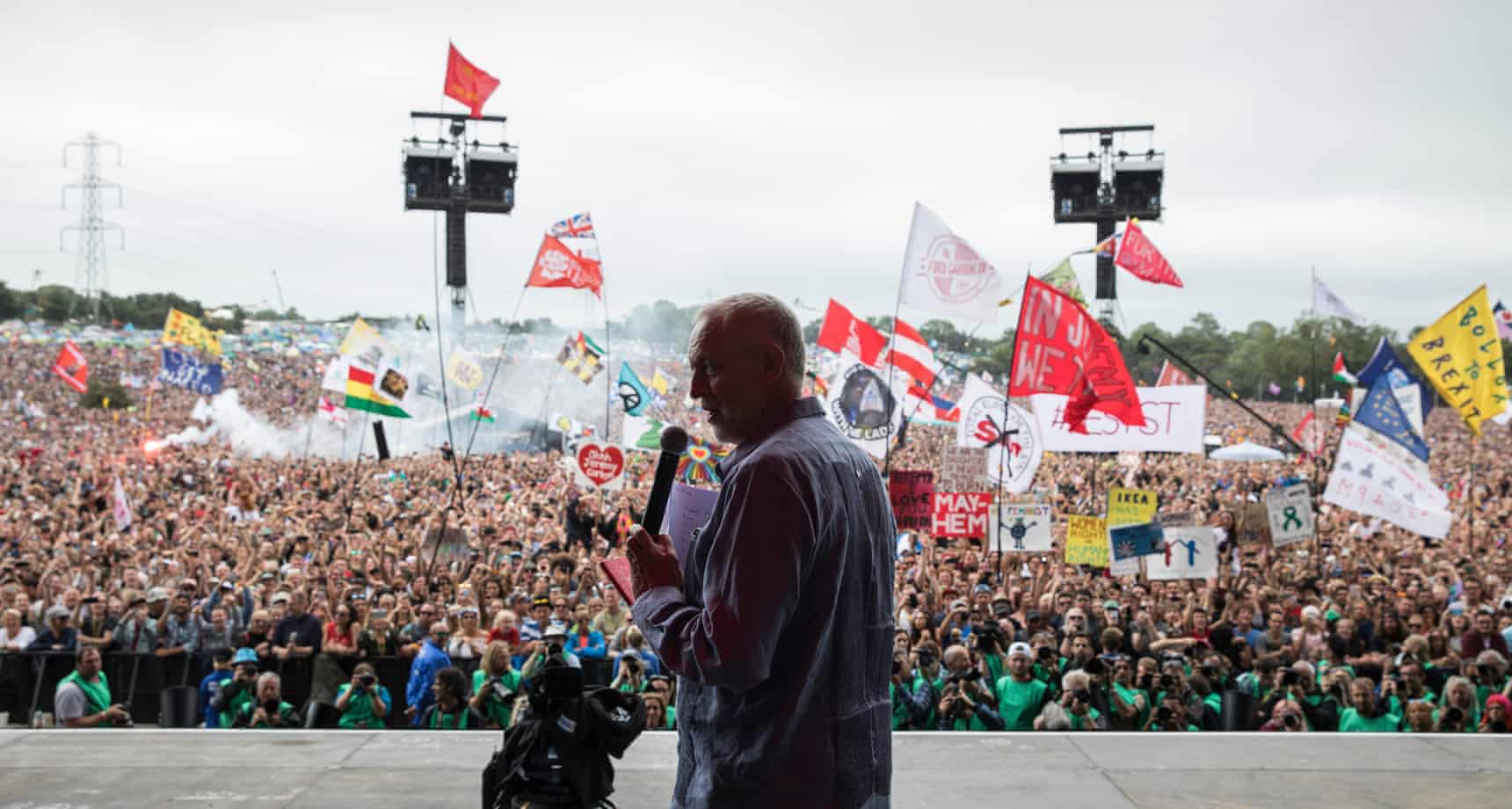
Jeremy Corbyn is an apt (and in light of the events since December, tragic) example here: a soon-to-be-lost symbol of a fleeting moment when the British left was Pop.

Initially, at least, Corbyn was a leader who understood that socialist or communist principles necessitate not just a particular way of thinking and speaking but also a totally different way of living. In this sense, Corbyn embodied the promise of Pop: rather than living the usual life of a politician, faithfully following the Oxbridge-to-Parliament pipeline, he came to the Labour leadership race in 2015 with roughly 40 years of community organising, union activism and anti-imperialist solidarity under his belt. The “common” programme for being a politician or Leader of the Opposition was scrambled in every sense, in a Pop-style nihilation. Huge sequences of the code were deleted (the polished Oxbridge attire; the PR soundbites; the narrow nationalistic viewpoint and pandering to anti-immigration sentiments) and new sequences were inserted (a commitment to the grassroots; anti-austerity; genuine interest in literature and culture). Corbyn sceptics in Labour, usually on the liberal or soft left, frequently derided this scruffy scrambling of the accepted codes of politics as frustrating “baggage”, particularly in regards to his anti-imperialist solidarity work. But this “baggage” was precisely what made Corbyn a quasi “pop star”, a genuine cultural icon, that was at the centre of the 2017 almost-victory. It’s hard, for instance, to imagine something like Grime4Corbyn happening without Corbyn’s history in (or “baggage” of) anti-racist and anti-imperialist organising, as grime artist Akala’s support for him demonstrated. It was the “baggage” that made Corbyn Pop.

*

But for all this exaltation of Pop, content still – clearly and necessarily – matters. Pop is ultimately a kind of ambivalent form that can feed upon a whole range of common codes, substances, and molar aggregates. A Pop Communism*** still, therefore, depends on that set of common principles, theory and policies that all leftists are at least somewhat familiar with and advocate for. But the point nonetheless remains that good policies aren’t enough, and never will be enough. In honesty, I couldn’t care less that all of the leadership contenders are standing on a platform that has substantial bits of “Corbynism” in them. Instead I want a leadership candidate that will stand in front of everyone and say the unthinkable: that everything that was ostensibly bad about Corbyn, all his “baggage” that even the left took turns in complaining about, was precisely the most valuable thing about him. The beige suits, the history on the backbenches, the anti-imperialist solidarity, the eccentric anecdotes and hobbies, that’s what we wanted, and what we still want. It was what made Corbyn, and Labour, ever so briefly Pop, reaching its crescendo in the aftermath of the 2017 election.

2017 Corbyn “won”, for all intents and purposes. 2019 Corbyn lost.

We collectively gave up Pop and settled for “popularity” and “common sense”.

We can’t make the same mistake again.


-----------------------------

*I am not trained in biology, so this is massively generalised, and I welcome insights from virologists and epidemiologists on this matter.

** Pop, then, is a particular form of expression (as opposed to a form of content – this is why Pop music covers so many different genres and can hardly be labelled a genre in itself)

*** As I think about it, I think Pop Communism is basically the same as Acid Communism. Or at least very similar. So this neologism may be completely redundant.

20 February 2020

Exiting The Academic: Thoughts On Objectivity and the Neurotic-Perfectionist Drive

It's always about getting past that barrier: the psychosocial barrier of embarrassment, the fear of nakedly putting something "out there", of exposing oneself.

I write, I try and cobble some things together. At the slightest hurdle I convince myself that this whole labour is pointless, that actually completing this and trying to publicise it would just be a deeply embarrassing thing to do, because no one actually cares, no one is going to read it, and I haven't done anything interesting.

All this represents is a desperate attempt to cling on to and control a piece of writing. This is why my mode of writing has historically so often been perfectionist and obsessed: no, I can't do this until I've read x y z and become an expert... no, I can't possibly write this sentence without considering a few other things from this author I just remembered... must populate sentences with parentheses in order to be as specific as possible, not leave any room for misinterpretation, not appear like some idiot who hasn't considered every dimension... Such a mode of writing leaves a stench. It lingers in the air of every university. It reeks of the academic obsession with "objectivity", the internalised boss-cop in the head that is always demanding order, always demanding more data, always demanding things are more clear, more visible, more controllable.

The ironic thing is that this neurotic mode of writing that seeks to "perfect" it more often than not makes it less perfect, transforming a more-often-than-not interesting conceptual core into a garbled verbose mess that's boring and unjoyful to read. In accepting the gamble that any argument can be "perfected" within language - all we need is to cram in the right words, and lots of them - the neurotic-perfectionist drive reduces writing to a dull, tepid representation; an inert painting on a wall that eyes are constantly glossing over. The focus is almost completely on words and sentences as simply representations/signifiers with an internal semiotic "content", missing in the process how words and sentences function as a-signifying forms, effecting little movements, intensities, dopamine rushes, which mobilise the libido. 

The neurotic-perfectionist drive underpins the Academic as a particular aesthetic or style, defined in part by the denial of any style or aesthetic altogether. The Academic, as an ideal aesthetic limit-point that all “intellectual” or “theoretical” writing is inclined to tend towards, is a style devoid of all style: no flourishes, no lyricism or stories, and only the most constrained and forced turns of phrase and neologisms. Through such arse clenching, the Academic thinks it gets to the Real, the “objectivity” it puts so much blood, sweat, and anxiety attacks into uncovering, by stripping back all style, all emotion, all traces of libidinal intensity: aesthetic austerity.

But it doesn’t. Rather than revealing the Real through this act, the Academic instead deadens it: what we get is an Academic Realism, rather than the Real – a weird, undead performance of the Real that claims to be it. An unsatisfying reheated meal of academia’s greatest hits and citations, microwaved so many times so as to become an unappetising, and above all unconvincing, mush.

Realism is not the Real. Remember k-punk: ‘Realism has nothing to do with the Real. On the contrary, the Real is what realism has continually to suppress.’

(This is all of course a simplified argument. Clearly the semiotic "content" of the words we write matter, for one, and clearly this content is immediately bound up with its form. The takeaway argument, if there is one, is the age old adage that radical content must be equalled by radical form; that form, aesthetics, style, matters. Any writing that pays no heed to its aesthetics, its written form, as academic writing tends to do by treating writing simply as an inert carrier of semiotic content, is not worth its salt. Or, put more forgivingly, is limiting itself massively, keeping theory caged within the (classed, racialised and gendered) academy it dreams to be free from.)


I write all this as an attempt to grapple with the actual practice of writing no longer under the watchful eyes of the academy. I’ve always been easily embarrassed about my own creative pursuits, owing to persistent low self-esteem and my extreme childhood shyness. So when I started university, it seemed like the place for timid, depressed, and socially anxious me: place where any notion of “I” would retreat, where writing would simply be about some subject matter that “I” could distance myself from. Knowledge was what mattered, not “me”.

Unconsciously, the “structural” and the “personal” were held in opposition, even if I professed to believe the opposite. I saw myself as writing about implicitly “distant” “structural” things as a way to distract attention from “me”. Writing was always placed at a firm distance from my everyday life and modes of living. While this distance began to decrease when I started getting involved in student activism, it continued to persist (and still does). A constant disavowal and pushing away of the body, of the human meat puppet and its unconscious: its drives, instincts and neuroses. A piece of sandpaper always at hand, constantly and willfully eroding any trace of the human OS behind the text, ignorant of the fact that this will/drive only further proved and consummated the existence of the human OS. “Objectivity”, for all its claims to dispassionate empiricism, is always driven by a libidinal, unconscious drive. This is the neurotic-perfectionist drive that I found myself channelling, a slave to.

You don’t have to look far to see this in action, beyond my personal experience. Why do you think there’s a mental health epidemic in universities today? Why do you think so many academics are depressed and anxious? It’s at least in part because the academy is animated by objectivity, and objectivity is predicated on a particular drive: the neurotic-perfectionist drive that self-flagellates, that tries with futility to rid academic work of any trace of the human meat puppet, the ostensibly “subjective” element constantly muddying our access to “the Real”, despite being fully in the Real itself. Objectivity is always trying to tame, contain, and control the human OS, the unconscious; and what is anxiety if not the attempt to regain control?

The result of this neurotic-perfectionist drive is a mode of subjectivity much akin to Nietzsche’s character of the “objective man” that he skewers in Beyond Good and Evil:
He is only a tool; let’s say that he is a mirror, not an ‘end unto himself’. The objective man is indeed a mirror: above all, we must admit, he is accustomed to subjugating himself, with no desire other than what knowledge, what ‘reflecting’ can offer him. He waits until something comes along and then spreads himself out gently so that even the light footsteps of spirit-like beings gliding by will not be lost upon his surface and skin. (p.97)
The academic as a smooth, spread-out surface, achieved only through routinised self-subjugation, self-flagellation, self-deprecation.

*

By the end of my undergraduate I was pretty bored of this approach (which is rampant in the social sciences and humanities even on ostensibly radical topics), but didn’t know where else to look. Then I did my Masters, properly read Mark Fisher and Deleuze and Guattari, and realised that what I thought was “theory” was in fact an incredibly narrow slice of it, a mere faction, held hostage by an academia that resists the osmosis of theory into the Outside. (Mediums such as sound and video are almost always out of bounds.) The academy’s obsession with secondary literature and journal articles, coupled with its dull literalism and “objectivity”, had completely muted the thrill, the feeling of moving through a portal into a different world, that accompanies reading a good philosophy/theory book first-hand.

Fisher and Deleuze-Guattari actively shunned academic convention: Fisher basically never wrote for academic journals (although he did take part in numerous academic conferences and organised a major one on accelerationism in 2010 - he was no stranger to the academy, for sure) and instead put his heart into the noughties underground blogosphere, his short Zer0 books works, and his writing on television, film and music in more mainstream outlets such as The Wire or New Humanist. From my viewpoint it seems Fisher always tried to live by his concept of “popular modernism”, constantly trying to bridge the gap between the mainstream and the marginal or avant-garde, plunging into liminal, in-between spaces to later emerge with new, critical, and accessible insights: TV reviews that cited Lacan and Nietzsche (e.g.), and his music writing that (most famously) reanimated Derrida’s concept of “hauntology” being two examples of this. By necessity, this demanded a certain critical distance from and engagement with the academy, which certainly would not usually judge the above work of sufficient academic rigour.

Image result for anti oedipus cover

Deleuze-Guattari’s Anti-Oedipus meanwhile is written with an exuberant, militant flair that actively channels the post-68 spirit in France, which had not yet deflated by the time they published the book in 1972. Examples of this are numerous, with the book peppered with phrases like “fucked by the socius”, “Judge Schreber has sunbeams in his ass, A solar anus”, and “all writing is so much pig shit” (and that’s far from exhaustive). While such joyful and profane desecration is less present in A Thousand Plateaus or Deleuze’s solo work (to my knowledge), these works break with academic conventions in other ways: ATP famously is a non-linear book, where any chapter can and should be read in any order, and joyfully brings together a whole host of intellectual fields. Whereas AO’s theoretical foundations, which it departs from and sublimates over the course of the book, are largely psychoanalysis and Marxism (although the literary works of Artaud and Samuel Beckett are also formative, so this is reductive), ATP frequently falls back on the natural sciences, pulling concepts from fields like genetics, thermodynamics, cybernetics, and differential geometry and mashing them together to produce a joyfully weird – and difficult – text of philosophy.

What Fisher and Deleuze-Guattari give us hints of is what is intellectual practice can be like when unshackled from the Academic, and provoke us to further ask: How can intellectual practice look and feel different? I don’t have a total answer to that, but as this post argued, approaching an answer will involve (1) embracing and taking seriously style and aesthetics and (2) going through embarrassment (and fear, and denigration), making deviations and experiments that by their very nature will provoke and shock the collective unconscious into defence mode.

Theory freed from the Academic – freed from “in this paper I will argue that”, a mode of writing which mainly only appeals to other academics, and paper presentations that consist of a mild-mannered white man reading from a laptop in a stuffy lecture theatre – may not be theory in any form we currently recognise it. It may elicit shock, derision or laughter. So be it.

9 February 2020

I am nothing but I should be everything

The Fisher-Function has routed itself so thoroughly in my neural circuitry that I am no longer just echoing and citing k-punk (at an almost embarrassingly high frequency) but anticipating its thoughts accurately. Upon reading some posts on Nietzsche in an attempt to help me get some bearings on the notorious philosopher, I came across this passage from a 2006 post that spectacularly wires together Nietzsche and Celebrity Big Brother:
[...] because Big Brother and reality TV have effaced those areas of popular culture in which a working class that aspired to more than 'wealth' or 'fame' once excelled. Its rise has meant a defeat for that over-reaching proletarian drive to be more, (I am nothing but should be everything), a drive which negated Social Facts by inventing Sonic Fictions, which despised 'ordinariness' in the name of the strange and the alien.
This "proletarian drive to be more" is the same drive I noted in my post on surpluses from a couple of months back, where I discussed "the craving for a more that is almost never satisfied" that exists amongst the working class (having not read any of these k-punk posts previously). Whereas I mentioned this craving in a kind of off-the-cuff way, Fisher adds an important political dimension to it; namely, by explicating how this drive has had to be explicitly quashed from capitalist realist popular culture, through a veneration of the "ordinary" and the "relatable". Fisher's then-contemporary point of reference for this is Celebrity Big Brother but the cultural impulse remains strong to this day, evidenced in the latest iteration of reality tee-vee (Love Island) and "everyday" sitcoms (see the hype that accompanied the Gavin and Stacey Christmas comeback special). Popular culture continually opts for the "ordinary", "relatable" and "comfortable", never inviting the working classes to desire anything more.

This desire and striving for working-class excellence and achievement, explicitly defined against its dominant bourgeois opponent (two kids, a nice piece of real estate in the home counties, and a managerial job on £70k+...), is not the phantasmatic invention of desperate leftists idealising the working class. At one point, at least in Britain, it was a significant social and cultural force. Simon Reynold's book on post-punk from 1978-84, Rip It Up and Start Again, which I've been reading lately, attests to this over and over again, detailing the background stories of numerous post-punk groups from the era and their position on post-punk as a genre, aesthetic and philosophy. Post-punk, of course, was the protest against the ossification of Punk, its solidification into a Punk™ that fetishised a kind of ordinary, "authentic", overtly macho, "common-sense" Punk that soon became the Oi! movement. In post-punk, therefore, one found swathes of working-class artists (John Lydon, Mark E. Smith, and the late Andy Gill of Gang of Four being just a few examples) resisting their mandatory reduction to the "ordinary" by virtue of them being poor or ostensibly "uneducated", doing so through a whole-hearted embrace of sonic experimentation and genre cross-contamination (dub and reggae were particularly big influences). And, most importantly of all, these post-punk artists weren't experimentalist fringe nobodies but people situated on the bleeding edge of popular (music) culture, hyped up by the then healthy music press (NME, Melody Maker, Sounds, etc) with major label contracts and big record sales. Post-punk became the release valve for the "proletarian drive to be more" and then routed it back to the public, amplifying the proletarian drive. That kind of hyperstitional system is pretty much completely absent from the current social and cultural landscape, and its revivification should be a key long-term goal of contemporary cultural and political struggle.


The constant presence of class in Fisher's writings, both conceptually and above all else affectively (evident in the sharp wit and resentment of the ruling class that permeated all his work), is one of my favourite things about it. Because, and I know this is not a particularly original insight to make, but class, any discussion or even just acknowledgement of class, is just completely and utterly absent from (British) popular culture right now. Not even Corbyn did much to shift this, perpetually opting for the moral critique of austerity capitalism (as indicated by his favourite soundbite, "grotesque levels of inequality") rather than an advocacy for class conflict (he/Labour very rarely used the words "working-class" or identified them as their driving subject).

This is why watching Parasite at the Barbican yesterday was, above all else, so completely refreshing. I haven't seen a film that depicted class conflict so brilliantly perhaps ever (disclaimer: I do not watch many films), and key to this was the kind of casual, humorous spearing of the upper class family in the film by the poor under-employed family who are the protagonists. This wasn't even class resentment, it surpassed and transcended resentment by taking it for granted (yeah, of course rich people are useless parasites, that's why we're mocking them) and using it as the foundations for a dark and ironic humour that repeatedly put the audience in stitches. We need more fictions like that in the realm of popular culture.

19 January 2020

For and Through Embarrassment


A new, more substantial, post is in the works, but in the meanwhile I wanted to quickly share the following passage from a piece I stumbled across last night from Robin Mackay, entitled “Nick Land: An Experiment in Inhumanism”, written back in 2011. In it, Mackay recounts some first-hand experience of being a student of Land’s back in Warwick in the mid-1990s, shedding some interesting light on the oft-demonised thinker. (Disclosure: I have not read Land and I don’t disagree that the shunning of the contemporary, neo-reactionary Land is the right position.) Putting that relatively aside for one moment, however, there’s no doubt that the account Mackay gives on Land has interesting implications for academic and intellectual practice; Mackay, for instance, cites Iain Hamilton Grant, a former student of Land’s, who states that ‘In the last half of the twentieth century, academics talked endlessly about the outside, but no-one went there. Land, by exemplary contrast, made experiments in the unknown unavoidable for a philosophy caught in the abstractive howl of post-political cybernetics.’ Anyone who has had even the slightest brush with academia will be aware of the figure of the “radical academic”, the people who wax lyrical about destroying dominant ontologies, epistemologies and ideologies (etc) and yet completely abstract it from their everyday practice, living frankly boring 9-5 lives that counteract all the promises of their “radical” philosophies. In Mackay’s account, 90s Land seems to signal some way out of this, a way of living philosophy, of fully committing oneself to the life philosophy demands of us. Mackay writes:

In taking this approach, Land not only renounced the respect of his academic peers, but many times even lost the confidence of his supporters, as he sought by any means possible to drill through the sedimented layers of normative human comportment. Strange scenes ensued […] most memorably, a presentation at the conference Virtual Futures in 1996: Rather than reading a paper, in this collaboration with artist collective Orphan Drift, under the name of ‘DogHead SurGeri,’ and complete with jungle soundtrack, Land lay behind the stage, flat on the floor (a ‘snake-becoming’ forming the first stage of bodily destratification), croaking enigmatic invocations intercut with sections from Artaud’s asylum poems. […]. As Land began to speak in his strange, choked-off voice […], the disconcerted audience began to giggle; the demon voice wavered slightly until Land’s sense of mission overcame his momentary self-consciousness; and as the ‘performance’ continued the audience fell silent, eyeing each other uncertainly as if they had walked into a funeral by mistake.
Embarrassment was regarded by Land as just one of the rudimentary inhibitions that had to be broken down in order to explore the unknown—in contrast to the forces of academic domestication, which normalised by fostering a sense of inadequacy and shame before the Masters, before the edifice of what is yet to be learnt—thus reversing the libidinal charge of the ‘unknown’ and turning it into an endless duty, an infinite labour.

Again, anyone with any experience in academia (and elsewhere, to be honest) will know this experience of embarrassment, of not wanting to do something slightly out of the ordinary out of a fear of public shame, audible whispers and giggles, singeing through one’s ear canals straight to the fragility of one’s ego. Is not the whole of the academy run and based on this fear of embarrassment? The desire to be approved by the ‘Masters’? Perhaps this is why most academic writing is so tedious, scattered with the latest trendy neologisms that seem to refer to nothing but their own ostensible self-importance – because it is constantly, desperately, trying to prove itself as a way of deferring embarrassment, with this proof always pointing to some external, immutable Real that the Masters unquestionably take as fact. (Power and (epistemic?) realism being bound together, as Baudrillard argues in Simulacra and Simulation: ‘The only weapon of power, its own strategy against this defection, is to reinject the real and the referential everywhere, to persuade us of the reality of the social, of the gravity of the economy and the finalities of production.’)

Perhaps we can speculatively say that (a particular kind of?) embarrassment is a weapon for containing and muffling the divergent, which, just as Nick Land did when he was croaking and writhing on the floor, must ‘be broken down in order to explore the unknown’, to break intellectual practice out of the confines of the academy and into a new way of life.

It’s important to note that the argument I’m building here isn’t a demand, often made by (understandably) exasperated undergraduates on Twitter, for philosophers, theorists, and writers to “be more clear” or “use more simple language”. The argument (though it’s more an unconscious disposition) here always seems to be that Foucault (or whoever) is too hard to read, and that this is entirely because intellectuals wilfully make their work obscure out of some egotistical drive to appear mysterious and important. While there’s a kernel of truth here (see below), there’s also a micro-policing that I’m not entirely comfortable with, a refusal to give oneself over to the other, the new, and the unknown in favour of a “I’d like to speak to your manager” tendency, a conservative demand for things to be easy and cater to one’s existing way of life, which is of course impossible for any one piece of writing to do. It also baffles me because the difficulty of reading, say, Foucault, or Deleuze-Guattari, or Spinoza, is part of their very value and joy, indexing a pathway to a whole new conceptual world and way of living one’s life. That’s not to say these thinkers should not be made more accessible for people less versed in philosophy – this is absolutely important work, and they should – but that’s the function of secondary literature and work, which picks up bits and pieces from the primary work and elaborates on them, or plays with them, in a specific context: much like the primary work did with the sources it builds off. Don’t demand totalising interpretations; copy, create and mutate…

The issue, then, isn’t really the difficulty of the language but the functions it expresses. Academic language can be tedious, but it’s not so much because it takes effort to understand it, but instead because it seems designed to appease the Masters, to fit in with dominant trends within particular fields, rather than build any useful conceptual machines that people can use to live better lives. Examples of this in academia include always citing the “right” people (in ways that are often supremely gendered and racialised, too), using the “right” terms, and discussing the “right” topics. The challenge for intellectual practice is to shake off the demands of this conformity, and rather than perpetually defer embarrassment and exposure, work through them. Embrace and work through embarrassment, because what it indexes is the Masters attempting (and potentially failing) to keep their grip on their accepted programme of reality – not a personal failing. (That’s what they want us to think.)

*

Above all, the challenge for intellectual practice (no longer conceived academically, as abstracted from everyday living purely to be distributed across academic journals, conferences, etc) is to be consistent in one’s principles. I make this point inspired by a k-punk post from 2005 that’s been bouncing around my head for a good month now, having brought together and articulated nicely some thoughts I’ve been low-key having for a while (many of which have now been messily expressed above). Fisher writes:

The challenge of religion is to live your conviction. Kierkegaard's injunction that we leap into faith should be taken less, as is normally done, as a demand for the subsumption of reason into the irrational, but as a call to show fidelity to your conviction. This was what Kierkegaard meant by deriding those who merely 'believed' but who lacked 'inwardness'.
To be genuinely religious is, above all then, to rise to the challenge of consistency. Which is why the Rationalist tradition in Philosophy is religious, whereas the Empiricist tradition, based in commonsense and experience, is atheistic. Hence Spinoza's flattening of ethics into geometry versus Hume's claim that the only answer to the dilemmas of Philosophy was to forget about them and play billiards.

Our intellectual practice should be (tied to) a quasi-religious conviction and commitment, a consistency that stretches across all aspects of our lives. It’s custom to scoff at, or be suspicious of, this kind of consistency today, in a way that is unconsciously designed to shame or embarrass the committed. (Small personal example: I refused to shake Goldsmiths senior management’s hands at my Masters graduation ceremony last week on account of them being managers on £200k+ salaries while students and staff suffer with debt and precarity, and who called the bailiffs on the anti-racist occupation at Goldsmiths six months ago – this prompted a somewhat puzzled reaction from my parents and, I presume, those watching.) Chill out! Stop being so serious! It doesn’t really matter! But in these very cries is the plain and simple attempt to keep the problems of politics and philosophy out of the realms of everyday life, to keep them as the abstract playthings that the Masters/capital want(s) them to be. For, unlike previous social formations, capitalism is more than happy to accommodate a whole host of varied belief systems and philosophies (within relative limits), but only if these belief systems are relegated to the status of individualised “opinions” or “faiths” that are basically inert and ineffectual. As soon as these belief systems, particularly the ones explicitly hostile to capitalism, try to actualise themselves into certain behaviours, certain shared ways of life, however, capital must rush to neutralise the threat; and the collective unconscious we embody together is the tool it uses to do it.

The consistency Fisher speaks of above, then, is a lived practice of constructing a flat continuous line between belief and behaviour, which necessarily involves breaking down and through a bourgeois shame and embarrassment that seeks to keep beliefs in their place as fanciful “ideas”. The actualisation of the virtual spectre of communism – or even just the Outside – demands nothing less.

5 December 2019

Demand More: #GE2019 and the Politics of Surplus


It’s been incredibly humbling over the past few weeks to see people value, share, and stick up the election posters I designed in a spur of the moment one evening, as pictured above. While I of course designed them to go viral, I never actually expected it to happen, let alone become the inspiration for a massive banner made by Manchester Momentum and cited in a recent VICE article by Lauren O’Neill. (I’m yet to get over my excessive self-criticism which deems every piece of work I complete, including this very post, as irrelevant, useless, and a waste of everyone’s time; I’m working on it.)

On an (im)personal level, the posters stemmed from a profound frustration and exhaustion I’ve been feeling over the past few months, as I have transitioned out of the fragile safe-haven of the university and fully into the world of work. Currently I work as a one-to-one teaching assistant in a primary school in South London, specifically supporting a child with global developmental delay, teaching them everyday how to read, write, do maths, and so on. Even though the working conditions of the job are better than many (including myself) have become accustomed to in a precarious economy (I have a contract, a salary, I get paid sick pay, free hot lunches, e.g.), the fact of the matter is that my rent takes up over half my income and I still more or less live paycheque to paycheque, making little savings. Beyond economics, too, the job is absolutely exhausting on a very deep emotional level, and takes significant time and energy away from my weeks that I would much rather prefer to spend doing the things I’m passionate about: writing, studying, creating, and campaigning.

But, as hinted towards above with the “(im)personal”, these struggles are anything but personal and individual. I know for a fact that other workers in the school share my malaise, as do workers in a whole host of sectors in the UK and across the world. “My” exhaustion, depression, anger, are anything but mine: instead they are the impersonal expressions and effects of capital as a virtual body that distributes labour and (re-)production in a specific kind of way. And if those feelings are impersonal, the working of some kind of social machine, then they immediately become a political issue, and the object of intervention for political propaganda and aesthetics. And given the fact there is currently a general election campaign ongoing, where the Labour Party (for all its massive faults and profound limitations) is standing on a programme that could drastically ameliorate these feelings of frustration and transfer power to the working-class in the UK, the posters were the natural outcome of this line of thinking.


Demand More

After I posted them on Twitter, I noticed a shared theme among the posters that hadn’t even occurred to me while designing them. Namely, three out of four of posters invoked the notion of more. (Demand more from life; there’s more to life than this; do you really want more of the same?) What is this more? Why is it valuable? Why does it form a part of a radical working-class politics? What do we demand when we demand more? What do we mean when we say “there’s more to life than this”?

Swap out the word “more” for “surplus”, and the way forward here becomes a bit clearer (the concept of ‘surplus value’ is Marxism 101, for example). To have a surplus is to have more than necessary; to have a quantity of something that exceeds the amount needed for a particular task to be completed. A surplus is therefore always defined in relation to a certain task that needs to be completed; it derives its definition from a prior code or programme of use. It’s only possible to define, for example, an office of one hundred computers as having a surplus of computers if it doesn’t have a code of use that incorporates them. Hire more staff, work out things for them to do (a.k.a. incorporate them into a programme/code), and soon enough those computers will no longer constitute a surplus – they’ll just be what’s required to do the job.

Surpluses, therefore, don’t simply possess a quantitative character – they possess a qualitative one too. When a surplus exists, one escapes the logics of pure utility and functionalism and consequently finds themselves on much more open, and creative, terrain. Surpluses are that which escape a code, that a code cannot or does not incorporate, and therefore express what Deleuze and Guattari term in A Thousand Plateaus the “essential margin of decoding” inherent in any code:
The modern theory of mutations has clearly demonstrated that a code, which necessarily relates to a population, has an essential margin of decoding: not only does every code have supplements capable of free variation, but a single segment may be copied twice, the second copy left free for variation. […] Every code is affected by a margin of decoding due to these supplements and surplus values […] (ATP, 61)
In simpler terms, codes are non-exhaustive. Despite their ambitions, they never attain complete control over their inputs and outputs; an office computer may be intended for data entry, but it can also be used by the worker to browse social media and procrastinate at work, or to input false data in a bid to damage the company. The surplus is inescapable: you can block Facebook on work computers, fire trouble-makers, but you will never be able to stop people and things exceeding the code, detaching segments from it and linking them to other codes… there’s always an exit.

Qualitatively, therefore, surpluses express a freedom and openness that comes through an escape from the cold and literal functionalism of the code from which they are defined in relation to. This is the “joy” of surpluses, their ability to augment and increase our capacities to act (think of what you could do with an office full of one hundred computers free to be put to use!)

The “more” we demand thus reveals itself to be an intensive, not an extensive, quantity: an intensive quantity that, like temperature, cannot be increased or decreased without changing the very quality and character of the quantity. This sounds abstract but really is at work in many aspects of our everyday lives; it’s why genuinely free time feels so qualitatively different from time spent at work, for example. Work is boring, repetitive, and homogenous, as the capitalist machine tightly and rigidly organises our time according to a specific code of operation that we are mere cogs of, making labour-time a dull extensive quantity… genuinely free time, meanwhile, is relaxing, adventurous, exciting, heterogenous, intensive. (This is what is what we mean when we say we don’t want more of the same.)

Some of the posters put up by a friend & comrade in a marginal constituency in Chesire. 

The Politics of Surplus

It’s perhaps normal to treat surpluses as something exceptional and rare in life, a lucky moment of luxury or convenience that comes along once in a while. But really surpluses are everywhere – and this is where the politics of surpluses comes in. Georges Bataille famously argued in The Accursed Share that economics (and life more generally) in general is not structured around a lack, or scarcity (the so-called “basic economic problem” in mainstream economics), but rather a vast and interminable excess, originating from the superabundance of energy Earth continually receives from the Sun. And this excess is integral to the reproduction of life itself, for without surplus energy, a system/organism cannot grow or reproduce itself. In his words from volume 1:
I will begin with a basic fact: The living organism, in a situation determined by the play of energy on the surface of the globe, ordinarily receives more energy than is necessary for maintaining life; the excess energy (wealth) can be used for the growth of a system (e.g., an organism); if the system can no longer grow, or if the excess cannot be completely absorbed in its growth, it must necessarily be lost without profit; it must be spent, willingly or not, gloriously or catastrophically. (TAS, 21)
As Deleuze and Guattari chart in Chapter 3 of Anti-Oedipus, how surpluses have been produced, distributed and expended is central in determining how societies are organised historically (DGAO, 5). In what they term “savage” or “primitive” societies, for example, surpluses of specific goods are accumulated (such as cattle, yams, or cowry shells) according to local codes of value and significance. These surpluses are not hoarded but become the basis of ritual orgies of waste, expenditure and/or sacrifice (such as the North American potlatch) that are overloaded with meaning and symbolism (DGAO, 64).

Under capitalism, however, surpluses become reduced to mere quantities. Viewed from the inside of capital’s circuitry and operation, the surplus loses all its qualitative magic, symbolism, and freedom. Capital’s continual accumulation, self-expansion and displacement of its limits presupposes a universalisation and homogenisation, enacted through capital-money, which drags all production onto a continuous, divisible line on which all production can be directly compared, measured, and quantified. On this line, surplus can only be expressed and treated as (quantitative) profit, and all surpluses become comparable and equalised to one another (£50million in profits is always worth the same, whether it can from a restaurant chain or an oil company, despite the two qualitatively producing two very different things).

Simultaneously, and by corollary, the surplus’ relation to production and expenditure changes. No longer are surpluses produced to be expended, but instead to produce more surplus. Production is no longer subordinated to consumption/expenditure but to more production, the production enabled by the surplus. Viewed from within (not outside of*) capital’s logic, surplus is no longer than which escapes a code but instead captured by and incorporated into the very axiomatics of capital itself. Indeed, capitalism depends on the decoding effectuated by surpluses and its generalisation throughout society, for it is this decoding that allows production to beget more production, that allows capitalism to always expand and produce more profit. (For a more elegant theoretical explication of this argument, see the “The Civilized Capitalist Machine” section of Anti-Oedipus.)

The correlate of this process is the (re)production of a stratified class structure. For the dragging of all labour/production onto the continuous line, making all labour directly comparable, requires as its condition a monopolistic appropriation: human activities only become capitalist labour when they are made appropriable from the point of view of a monopoly power that fixes in position the boss/bosses/owners of production (ATP, 513; see also the rest of the “Apparatus of Capture” plateau). Labour under capitalism always flows upwards to some one power which stockpiles it; you always labour for someone, your work is always being appropriated; and it is this stockpiling of labour by a monopoly power that enables labour to be directly compared in the first place.

Surpluses in capitalism are therefore not only reduced to quantities, but crucially depend on a monopolistic appropriation in order to be so. In other words, surpluses here only exist when there’s someone to appropriate them (and thus benefit from them). Capital’s “flattening” drive (drawing abstract equivalences between disparate processes of production) is therefore simultaneously matched by a hierarchising one, which institutes apparatuses of capture, control, appropriation and enforcement which are designed to catch, record, code and quantize surpluses so that they can become the basis of further capitalist (surplus-)production. Thus is born the stratified layers of production/labour that motor the capitalist machine, all predicated on the hierarchy worker/boss (which soon enough becomes worker/boss/boss’s boss/boss’s boss’s boss/… and so on). Capital depends on labour, on the working-class, in order to survive, but it does so reluctantly; its real heart is with the tight-arsed, joyless managers, bosses and accountants who make sure any surplus, excess or overflow is going in the most “productive” direction. For their loyal efforts, the boss’s boss then skims off the surplus produced by capturing these surpluses and rewards the boss handsomely with higher wages, more autonomy, better working conditions, promotions, and perks. And so it goes on, up the capitalist chain, surpluses everywhere, always immanently begetting more surpluses… except at the bottom, where the effaced fact of capital’s existence – quantitative surplus(-values) depend on acts of appropriation, capture, control, and perhaps violence in order to exist – lies plain to see, and be experienced. No surplus here, just the primary acts of monopolistic appropriation, control and exploitation that allow the surplus to surface and be captured qua quantitative surplus (profit). Just the barking demands to “get it done”, to do what’s necessary (nothing excessive or outside the normal boundaries, please), from the boss.

Thus emerges the austere quality of pure utility that pervades working-class life – doing what has be done to get by and little else – and the craving for a more that is almost never satisfied. That craving isn’t illusionary, it’s the real desire for the surplus, the escape from the code and the logic of pure utility, that always exists but is systematically blocked to the working-classes (and other oppressed groups) through capital’s working. To be working-class is to be reduced to pure functionality, to be simply operational, to execute orders, to be continuously told by the boss (and the boss inside your head) to simply get the job done. Just do it, get it done, it doesn’t matter why (because knowing or discussing why in any depth isn’t needed to execute the task).

The working-class are those who never or rarely get to experience or enjoy surplus; their only experiences of surplus they have are the traces of its extraction: exasperated sighs, exhausted slumps onto the sofa, evenings vegetating in front of a screen. To be exhausted is to have been extracted from; to have been appropriated and used by capital’s apparatus of capture. The working-class are maintained as an afterthought, a subtraction: “Labour and surplus labour are strictly the same thing […] Surplus labour is not that which exceeds labour; on the contrary, labour is that which is subtracted from surplus labour and presupposes it” (ATP, 514).

To declare “there’s more to life than this” under capitalism is thus to affirm the existence of excesses and surpluses (of value, of energy, of time) as the condition for life itself, and to recognise these surpluses’ qualitative, rather than simply quantitative, character. It is furthermore to recognise that this “more” is not simply some vague hypothetical, but something real and actively blocked to most people under capitalism’s machinations. Above all else it is a demand to ride the decoded flows set in motion by the qualitative surplus in ways that cannot – initially – be apprehended by the capitalist machine, and thereby expose its limits. What would happen if every member of the global working-class were to enjoy the same enjoyment of surpluses, excesses and (perhaps) luxury, both quantitatively and qualitatively, that bourgeois managers and bosses currently do on a regular basis? If everyone was always able to experience the qualitative “more” that so plainly characterises life and reproduction? Capitalism could not accommodate such a system; that’s why we always push further, ride the decoded flows into something beyond capital, demand more.


----

Notes
*: It’s important to stress the “not outside of” here, otherwise there may appear to be a contradiction with the argument made a few paragraphs above. Surpluses don’t just completely become quantitative and incorporated into capital with the onset of capitalism; such an argument is ridiculous. But viewed from “within” capital, from the viewpoint of capital and the figure of the capitalist, surpluses do appear, and are treated as, quantitative (more production = more money), and this is the point made here.

References
ATP = Gilles Deleuze and Felix Guattari, A Thousand Plateaus. Translated by Brian Massumi. 2013. Bloomsbury: London.

AO = Gilles Deleuze and Felix Guattari, Anti-Oedipus. 1983. University of Minnesota Press: Minneapolis.

TAS = Georges Bataille, The Accursed Share, Volume 1: Consumption. 1988. Zone Books: New York.

DGAO = Eugene W. Holland, Deleuze and Guattari’s Anti-Oedipus: Introduction to Schizoanalysis. 1999. Routledge: London.

4 November 2019

Satire Won't Save You, Part 1: "The Day Shall Come"s Simulacrum


Amidst resurgent fascisms and cut-throat neoliberal reforms across the globe, one would not be blamed for giving up on satire. ICE detention centres, spiralling homelessness, migrant slave labour: what use is laughter, parody and irony here? One can’t help but watch shows like Last Week Tonight, Have I Got News For You, or The Daily Show and feel they are completely toothless: an embarrassing and transparent charade of opposition which in actuality shore up the dominant powers. [1]

Chris Morris’ Channel 4 interview last month, promoting his new film The Day Shall Come, however, has breathed new life into this debate. In a widely shared clip, Morris poured scorn on “a kind of satire which essentially placates the court”, authoritatively advocating for a comedy with “a purpose” that actively tries to change something. With a refreshing moral seriousness and clarity of ambition, Morris affirmed that he did not feel outflanked by the perpetual outlandishness of world politics today and the likes of Trump, asserting that “yeah, you need to take notes pretty fast right now, but I don’t think [Trump’s] escaped ridicule … you’re always going to be able to ridicule someone like that”. Satire’s not dead, for Morris; it’s just being done wrong. A firm commitment to satire as a weapon undergirds Morris’ interview; he doesn’t care that Trump is outlandish, because he knows that reality has always been outlandish, and that comedy intervenes in that (rather than operating separately as the work of the individual author’s imagination). “It’s about the thrust, and it’s really about whether the people you’re lancing can get off your spike”, he declares. “And I’m saying the FBI really cannot get out of the tractor beam of this comedy.”

The question is: is Morris’ faith misplaced? Does The Day Shall Come embody a revived and weaponised satire for our current times? Or does the lance dissolve upon contact? Is the lancer always-already themselves lanced? Do those in power want to be lanced? Do resurgent fascisms, neoliberal exploitation and state authoritarianism demand other modes of politico-aesthetic resistance?

*


The Day Shall Come is based on, and meticulously satirises, a particularly pernicious – and postmodern – operation of power. The short of it is this: the FBI concocts “fake” terrorist plots using real, unwitting targets, providing money, weapons and other resources for them via undercover informants in order to nudge them into detonating a fake bomb. This then acts as their catalyst to arrest the unwitting target on grounds of intending to commit terrorist violence, resulting in kudos (and other more material resources) for the FBI and generating the impression that the authorities are “on top of” terrorism in the anxious climate under the War on Terror. These stings aren’t rare, either – while exact numbers are hard to get, there have at least been multiple hundreds of these kind of fake plots, with Morris estimating at least 300 in his Channel 4 interview.

But “fake” is the wrong word for these schemes, because as their victims will attest to, and as The Day Shall Come painstakingly portrays, their impact on those targeted is very, very real. Such stings have an almost 100% conviction rate according to Morris, with prison sentences of 25+ years which break apart innocent families. The FBI’s retort here would be that these people would have been terrorists anyway; these stings are just a form of pre-emptive policing that catch criminals before the crime. But from the moment the authorities “pre-emptively” engage with those they have identified as possible terrorists, and modulate their behaviour based on pre-existing plans for entrapment, any declaration that “they would have been terrorists anyway” becomes literally impossible to confirm or deny. The authorities never gain any grip on what these suspects are “really” like because as soon as they have been flagged as a target, and as soon as an undercover informant approaches them, the suspect has been coaxed into an elaborate simulation of reality. A non-simulated, or authentically “real”, response from the suspect can’t be attained; they’re always-already in the game of the simulation for the FBI, always-already being tested, nudged and probed, and any response can only be understood in relation to this. Here the distance and ontological hierarchisation between fiction and reality disappears as the racist and classist models of “radicalisation” and what a “terrorist” looks and/or acts like pass into, perforate and affect the Real, rather than simply “reflect” or “model” it from a distance. As cultural theorist Jean Baudrillard prophesised in 1976:

The old slogan 'reality is stranger than fiction' … has been outrun, since there is no longer any fiction that life can possibly confront, even as its conqueror. Reality has passed completely into the game of reality. Radical disaffection, the cool and cybernetic stage, replaces the hot, phantasmatic phase. [2]
These terrorist plots, then, aren’t “fake” or “false”; but they’re also not simplistically “real”, either. Instead, they’re simulations, a strange kind of “game” of reality [3]. The powers that be such as the FBI will always officially efface this, needing the firm ontological terrain of the Real in order to ground and legitimate themselves, but the fact is no such terrain exists.

If this all sounds like a stretch, or needlessly abstract and “postmodern”, I’d recommend watching The Day Shall Come, which brilliantly depicts the sheer absurdity, unreality and weightlessness stalking underneath these terror stings. The film follows Moses (Merchánt Davis), an impoverished leader of a small religious commune, the “Star of Six”, in Miami. Worshipping an eclectic mix of six deities (Allah, Melchizedek, Jesus, “Black Santa”, Mohammed and General Toussaint), Moses preaches a black revolution against the white man, but strictly without the use of firearms. “We trust only the weapons of tradition”, Moses declares in a sermon. “The sword, the sling… and the crossbow.”

Following the failure of a previous sting, the FBI seek out new suspects who can be the centre of their simulated terror plots. Moses, preaching to “overthrow the injustice of the white European” and declaring that “the cranes of the gentrificators shall fall”, seems just the fit for them, and soon enough informants are in contact with Moses, with one promising him money and firearms while posing as a sheikh affiliated with Al-Qaeda.

After this initial point of contact everything spirals out of control as each side tries to play and deceive the other in an escalating game of reality (sometimes without even realising it, in Moses’ case). The result is the fabulously absurd climax of the film, which starts when Moses agrees to purchase uranium from the FBI informant. Unkeen to actually use the nuclear weapons, however, the Star of Six fill the empty nuclear cannisters with piss and beans (the actual uranium being given to them the next week), in order to sell them for $100,000 to a neo-Nazi group and thus get some much needed cash for their farm. The neo-Nazis, however, are undercover Miami police officers, and having been promised supposedly real nuclear weapons, prompt the police department to declare a nuclear emergency. A team of police officers are on their way to arrest Moses and the Star of Six for supplying nuclear weapons that are in reality piss and beans inside cannisters supplied by the FBI. Having compromised their simulated nuclear terror plot and taken it as a real threat, the police and FBI soon butt heads, and the latter rush to diffuse the situation and regain control of “their” simulation. Hurriedly, they find the phone numbers for the “neo-Nazis” and get them to call off the arrest, letting Moses and the Star of Six go.

The FBI think they’ve solved the problem, but soon find out their efforts have been futile: word of the situation has reached the Oval Office, causing the Department of Homeland Security to declare a federal nuclear emergency on the fake piss-nukes. Dozens of police cars and armed police officers are now following Moses, unbeknownst to him, as he travels to his daughter’s birthday party. The fiction, once again, has outpaced reality. Faced with this farcical scenario, the FBI agents find themselves conforming to a twisted, backwards logic. They know the emergency is groundless, but it’s out there and believed, so in order to control it they have to act as if it were genuine. The bemused FBI agent Kendra (Anna Kendrick) summarises the quandary as follows: “So… to stop a nuclear emergency I have to declare a nuclear emergency?” “Yes”, her boss replies. “The logic only works if you say the sentence slowly. Keep the contradictory elements apart.”

Image result for the day shall come

As the cybernetic feedback loop(s) between Moses, the FBI and the police in The Day Shall Come accelerates, then, any firm ontological grounding or hierarchisation crumbles. What was simply designed as a fictitious threat to fool a supposed “would be” terrorist becomes taken as a real threat by a paranoid agency of social control that, operating under pre-emptive and anticipative models of terrorist behaviour, understands and respects no difference between signifier and signified and takes any sign of a real threat as a real threat in itself. The code, the programme, the model, the operation, is coldly literal; it seeks pure operativity and functionality, not symbolism and metaphors. The results here are dark and disturbing: the Star of Six are all sentenced to 25-35 years in prison, the same outcome as if they had actually committed a terrorist plot without any external intervention.

Try and start on any firm division between reality and fiction here, and you’ll end up precisely where everyone in The Day Shall Come ends up: in a strange blend of reality and fiction – in other words, a play of simulations; Baudrillard’s hyperreality. Dig for any firm reality principle and you’ll come up short, inevitably finding the absurd circuitry behind the screen, as the FBI agents in the film find themselves enmeshed in. It’s all like that Baudrillard passage from Simulacra and Simulation:

Organize a fake holdup. Verify that your weapons are harmless, and take the most trustworthy hostage, so that no human life will be in danger [...] You won't be able to do it: the network of artificial signs will become inextricably mixed up with real elements (a policeman will really fire on sight; a client of the bank will faint and die of a heart attack […]), in short, you will immediately find yourself once again, without wishing it, in the real, one of whose functions is precisely to devour any attempt at simulation, to reduce everything to the real - that is, to the established order itself… [4]
But we don’t really “find ourselves back in the real” after these encounters, as the Star of Six at the end of The Day Shall Come would attest to. The absurd circuitry, the weightlessness, the simulation, has been exposed, and things aren’t quite the same afterwards. As the film ends and the credits roll, it haunts us. This shouldn’t have happened, but it did, and it does. We never find the “truth” in The Day Shall Come, we never return to any stable ontological ground, what “actually” happened never gets its comeuppance. The simulation just keeps on going as (if) real; we never get back to the “real” side of the mirror, and to be honest we were never there to begin with. Instead, we encounter what Mark Fisher in his PhD thesis Flatline Constructs, borrowing from William Gibson’s Neuromancer, terms the “black mirror”:

But what then does the black mirror show us, if not out own reflections? In part, the black mirror is another image of cyberspace black out – the catatonic “neuro-electronic void” or cut-out of conscious signal we have already discussed […] The black mirror, then, is the image of the noumenal event horizon beyond which we cannot go: what we “always” are “in the other world” we are “already” in. [5]
The black mirror haunts the arrest and severe sentencing of Moses and the Star of Six at the end of The Day Shall Come; it’s right there, in that uncomfortable feeling in our stomachs. The image was never a mirror(ing); it was always a simulation, the workings of a code… sure, this is probably something to embrace ultimately rather than deny – more on this in part 2 – but who can deny the unease one gets when one looks in the mirror and just sees black, when one thinks they can trust what they see before them, only to end up with 35 years in prison on cooked-up terrorism charges for it…

*

The Day Shall Come is a good satire of this weightless yet pernicious form of power – interesting, funny, morally serious. And yet, considering how deeply director Chris Morris understands this operation of power (spending years researching the film, interviewing FBI agents and victims), one wonders why he opted for satire as a politico-aesthetic mode to combat it. For doesn’t satire fall prey to the simulation, just as Moses does in The Day Shall Come? Ultimately, isn’t a satire on “fake” FBI terror strings just a simulation of them that will all too quickly be absorbed into the real, absorbed into the FBI (and other state agencies’) very functioning? If so, what does resistance look like? I’ll be discussing this more in part 2, which should be up at least within a few weeks or so.


[1] Mark Fisher’s “The strange death of British satire” is an excellent and succinct documentary of this trend. Available at: https://newhumanist.org.uk/articles/4919/the-strange-death-of-british-satire
[2] Jean Baudrillard, Symbolic Exchange and Death, p.75, emphasis added. (SAGE, 1993)
[3] It’s important to underscore that this doesn’t mean the racist and classist violence inflicted in these simulations is fake or “not real”, and thus unimportant. It’s not that reality is now fake, but that reality is increasingly fictional and fiction is increasingly real. The status of both “reality” and “fiction” have changed, blurring into one another. Reality is no longer what we think it is; same with fiction. But that doesn’t mean the real has disappeared and that everything is fake – this would be a crucial misreading of Baudrillard’s arguments.
[4] Jean Baudrillard, Simulacra and Simulation (no page numbers as I have a shitty pdf version) (emphasis added)
[5] Mark Fisher, Flatline Constructs, p.142. (Exmilitary Press edition)

6 October 2019

Theory-Fiction Radio


Far from needing theory's help, music today is already more conceptual than at any point this century, pregnant with thoughtprobes waiting to be activated, switched on, misused.
– Kodwo Eshun, More Brilliant Than the Sun, p. -003.

Two weeks ago I was at the always-wonderful DIY Space for London attending the re-launch meeting of their Radio Collective. Things are still very hazy and new at the moment, but there are ambitions for DIY to become a kind of community radio hub similar to RTM in Thamesmead, and this weekend we’ll be doing some training sessions and potentially recording 30 minute snippets of everyone’s potential shows in order to patch together a kind of “DIY Space Radio Variety Show”. (Needless to say, if you’re interested in being involved, send me a DM/email.)

I’ve been meaning to get into radio and podcasting for a couple of months now, and this seemed like the perfect opportunity to really develop that interest. Specifically, I’ve been interested in using radio/podcasting as avenues for exploring theory and music in new ways – ways not typically afforded by conventional structures (e.g. academia, mainstream radio, my everyday life routines, etc.). 1) Theory doesn’t want to be centred in the academy. It doesn’t want to continually adhere to conventions of “in this essay I will argue that…” or only be read by professors. It doesn’t want to be produced in precarious, low-wage conditions. Theory is hypostatised, deadened, by the academy. 2) Music is deadened by the continual onslaught on our free time, our dream time. Music becomes an appendage to everything else. Something to walk to work to, to exercise to, to cook to. Always subordinated to an exterior function. Even when music appears to be centre stage – in the club, in the venue, in the pub – it, again, is hemmed in by an exterior function: profit, or more specifically, the logics of capital. What would it mean to actually put music first, to emphasise the (production) process of music rather than its effects? To vibrate with music’s plane of immanence? To genuinely, fully, deeply, be lost in music, caught in a trap?

The gambit of the hypothetical podcast/radio project is: what if we solve both these sets of problems by bringing theory and music together in some kind of productive melange? Sometimes I read beautifully written, challenging and intriguing theory, and I often wonder how it would sound to (carefully chosen) music. Remember all those scenes in your favourite TV shows, where some moving speech is made with some stirring strings intensifying underneath? Then the credits roll, another song plays. You think about all the songs you would put to credits music if you were a director. That you’d end a film with. Where the cut of the credits cuts into the music’s plane and intensifies it. I always think about songs like that; I think about how they could be same but different, creatively mashed together with something else (narratives, stories, cinematographies) to construct accelerating feedback loops that dissolve the music and the visuals into one another to such a degree it becomes impossible to think the two apart. What is Shrek without “All Star”, what is “All Star” without Shrek? And what is Shrek-All Star without the reaction to and memification of Shrek-All Star? There’s a kind of symbiotic mutation going on here continually corroding and infecting reality’s established boundaries: it becomes impossible to think of songs “in themselves” or memes “in themselves” because the open connectivity is built into their very production.

Now, these strange cultural loops aren’t necessarily positive things, and nor do they necessarily produce anything of genuine novelty, innovation and wonder (hence the continual tendency for reboots, returns, sequels, prequels, you name it). However, the sheer speed and intensity of the process does present opportunities for theory, and the chance (if not the guarantee) to produce things of genuine – not simply apparent – radicality and novelty through a process of what Deleuze and Guattari would call “deterritorialisation” or a “line of flight”. Consider the plugging in of theory/philosophy, the contours of its concepts and the flows and rhythms of its text, into the above circuit. The rhythms, breaks and cuts of the music slide over/under the rhythms, breaks and cuts of the text (and vice versa), enabling new connections and constructing new continuums of intensity and feedback loops. A new production: not theory plus music, not music plus theory, not the dead theory of the academy, but theory-music, theory-fiction, another accelerating mutation.

An experiment in theory-fiction radio, then, would not be about propping up either theory or music as they currently stand. It’s not about making theory fun, or making music “intellectual” (although these wouldn’t necessarily be bad by-products). Instead it’s about establishing a kind of continuous circuit between the two, where music mines the resources of theory and theory mines the resources of music. As Mark Fisher wrote in 2005:

 The whole pulp theory/ theory-fiction thing was/is a way of doing theory through, not ‘on’, pop cultural forms. Nick Land was the key figure here, in that it was he who was able to hold, for a while, a position ‘within’ a university philosophy department whilst dedicatedly opening up connections to the outside. Kodwo Eshun is key as someone making connections the other way – from popular culture INTO abstruse theory. But what we all concurred upon was that something like jungle was already intensely theoretical; it didn’t require academics to judge it or pontificate upon it – the role of a theorist was as an intensifier.

Here's another quote from Mark Fisher (from an interview with Simon Reynolds) on music as a kind of conceptual/theoretical resource, or “lab”:

Music became the centre of the culture because it was consistently capable of giving the new a palpable form; it was a kind of lab that focused and intensified the convulsions that culture was undergoing. There’s no sense of the new anywhere now. And that’s a political and a technological issue, not a problem that’s just internal to music.

The notion of music being a “lab” is an important one, I think, and neatly distils the cultural and political impetus behind theory-fiction radio. If we are today facing a crisis of the production of the new, then maybe theory shouldn’t obsess with unravelling hidden “truths” or critiquing dominant discourses in order to “tell it how it is” (a disposition that can facilitate the reduction of political praxis into a kind of negative micro-policing that is all too prevalent on Twitter), but instead seek to act as an intensifier. New worlds are always-already out there. As Keir Milburn has noted, remarking upon Jeremy Deller’s fantastic documentary Everybody in the Place, “there are songs in which you can literally hear the proof that we have the collective capacity to remake the world”. Music channels affects/intensities that are rhizomatically open-ended, refusing to be contained in any individual form, always fleeing, always travelling, always taking us somewhere else – there is a reason why music makes us daydream, livens up our walks to work with hallucinatory images and rhythm, makes us picture other worlds, acts as a “lab”. Theory(-fiction) shouldn’t seek to arrest that (in this case musical) movement or expose it, but actively flow with it, play with it, intensify it, thereby enhancing our collective capacities to act and potentially incubating what I have called elsewhere “psychedelic consciousness”. This is the hope of theory-fiction radio.

*

As all this all demonstrates, the idea of wiring theory and music together is nothing particularly novel. Indeed, just this week Robin Mackay over at Urbanomic unearthed an old tape of a “performance” by the infamous Cybernetic Culture Research Unit (CCRU) called Swarmachines at a conference in Manchester in 1996. It essentially involves members of the CCRU including Sadie Plant, Nick Land, and the late Mark Fisher reading a CCRU text (which can be found in the reader here) over some “premium mid-90s jungle”, cut together with all the primitive editing software mid-1990s personal computing afforded. Disparagingly for me, perhaps, the result is pretty poor, or at least dated; the CCRU collective barely seem to give the music space to breathe throughout the performance, crowding it out with their infamous brand of verbose theory-fiction. As one of the Soundcloud comments puts it, “the second-hand embarrassment is unbearable”; another pithily states “bro it’s a bunch of quotes over music there’s nothing great”. The balance, relationship and fusion between text and music here just doesn’t seem quite right. The hyphen in “theory-fiction” never quite materialises.  

However, I can’t help but feel some sense of admiration for the intentions here. At the very least, it’s an interesting example that one can learn from and build off, demonstrating the narrow tightrope one must walk with theory-fiction. And as Mackay, himself a former CCRU associate, correctly argues in the podcast, the performance does “attest to the confluence of sound and text, or the mutual intensification of words and music, that was crucial to CCRU. And it’s continued to be important to many of us in various ways ever since then.” I've linked the podcast below if you want to listen: